
For employees
and works councils
Your work, your picture
A few times a year, you describe your own work — what you do, and what you would like more of.
JobColors turns that into a picture for you. It helps you see where your work fits you well and where there is room for something better. What happens next is your call: nothing moves without you.

The short version
What you do is visible — where your hours go, inside your team and beyond it. That is how work has always worked.
What you make of it — energy, wishes, direction — stays yours until you choose to share it.
At a glance
What JobColors means if you work here
JobColors helps you understand how your work fits you now and where there may be room for a better fit. An opportunity only becomes a conversation about you when you choose to open that door.
- Your input
- You reflect on your current work, what suits you, what gives you energy, your interests and where you would like to grow.
- Your picture
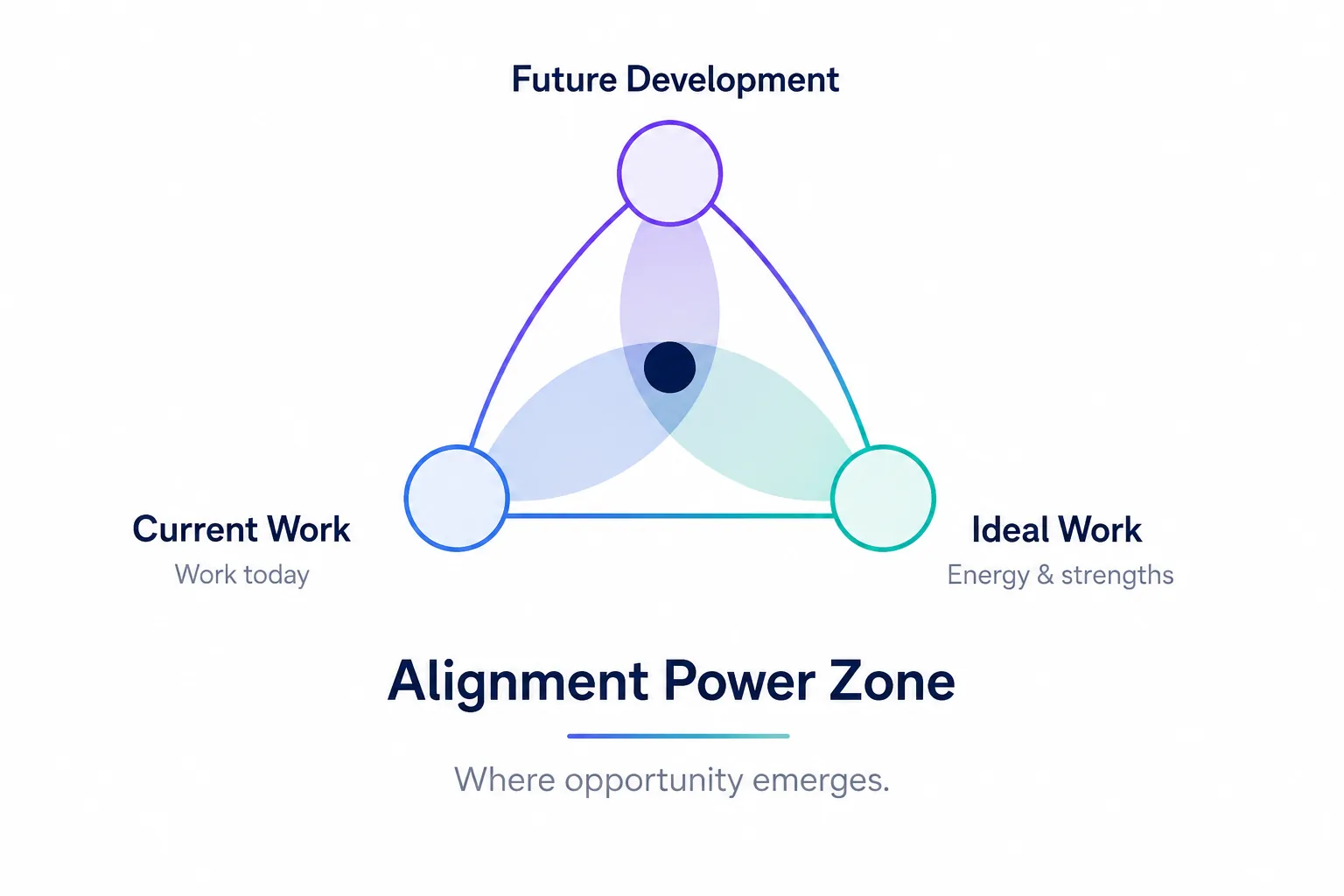
- You see how current work, ideal work and future development overlap — including where a better fit may be possible.
- Your choice
- Reflecting on how work suits you is voluntary. Personal opportunities are shown to you first, and sharing happens on your initiative.
- Organization view
- The organization sees aggregated patterns in work and capability. No team-level view is shown for groups smaller than five.
- The boundary
- JobColors is not an assessment tool and is not used for performance reviews, selection, ranking or evaluation of individuals.
- Works councils
- The method is designed to be examined: a DPIA, aggregation rules, permissions and governance boundaries can be reviewed.
What you see
Your own picture
Your own page brings together what you told us: the work you do, the capabilities and technologies you use, what interests you, what gives you energy and what takes it.
-
1
One thing to try Your page is built so that something stands out — one thing worth doing something about. Not a report to file away, but a starting point: pick one small thing to try, or one thing you would like to raise.
-
2
A reflection partner, if you want one You can invite someone from the enablement team to look at your picture with you. They see it because you opened it, and nothing leaves that conversation.
-
3
Opportunities elsewhere Work elsewhere in the organization that matches what you are good at and would like to do more of. These suggestions are yours alone — no one sees that they were made, or that you looked. Responding is what opens the door, and nothing happens until you do.
What others see
What you do is visible. What you make of it is yours
Three different things, not one. The team-level picture is aggregated — patterns, not people. Your work itself is visible the way work has always been visible. And what you think of that work is a separate matter, which stays closed unless you open it.
The work itself
Which areas of work your time goes to, and how much of it sits outside your own team. Your team lead sees this, because dividing work fairly is what the job asks of them.
What you make of it
What gives you energy, what you would like more or less of, where you want to grow. Closed by default — you decide what to open, and to whom, and you can close it again.
Nothing below five
Aggregated personal insights are not shown for groups smaller than five eligible people. Ordinary work information follows separate, role-based access rules.
Who took part
Your team lead sees how many people completed a round — nine of twelve — never which nine. Reminders come from the system, to you.
Why it is built this way
The line sits where it does for a reason. If what you said about your own work arrived on someone’s desk with your name attached, you would say it differently — and so would everyone else. The picture would look tidier and mean less. The privacy is not a courtesy wrapped around the method; it is the reason the method works. And it is what makes sharing worth something: when you do open your picture to your team lead or your colleagues, it is because it helps you — not because it happened to you.
The boundary
This is not an assessment tool
JobColors plays no part in performance reviews, selection, or evaluation of individuals. That is a boundary in the method, not a setting that can be switched on later.
There are no scores that rank people against one another, and no profile that follows you around. What the method describes is the fit between a person and the work — and your own experience of that fit is always valid.
Which also means there are no wrong answers. “This part of my work drains me” is information about the work, not a verdict on you.
For works councils
Designed to be examined
If your works council is reviewing JobColors, these are the points they will want to test. We would rather they check than take our word for it.
-
1
Data protection impact assessment A DPIA is part of the method and available for review, together with the governance rules the organization configures.
-
2
Aggregation and the privacy floor Team-level views are aggregated by design, and nothing is shown for groups smaller than five people.
-
3
Two kinds of input, two rules Reporting what you work on, with whom, and how your time is split is standard work information — the same as it has always been. Reflecting on that work, your energy, wishes and growth direction, is voluntary; declining to share it carries no consequence. Reminders go from the system to the individual rather than through a manager.
-
4
Scope exclusion Not used for selection, evaluation, performance assessment or profiling — a boundary in the method rather than a configuration choice.
-
5
Sharing on your own initiative Individual insight is closed by default and opened by the person — to a team lead, to colleagues, or not at all — and that choice can be reversed.
Questions are welcome
A works council that asks hard questions is doing exactly what it should. If something here is unclear, or you want to see the underlying documentation, ask your organization — or write to us directly.
FAQ
Common questions
What do I get out of JobColors?
You get a personal view of your work: what gives you energy, what fits less well, and where there may be opportunities to make a change. The aim is not to give you a long report, but to surface one insight or possibility you can actually do something with.
What happens if JobColors sees a good match for me elsewhere in the organization?
You see that suggestion first, and only you see it. No one else knows the suggestion was made or that you looked at it. Only if you decide to respond can it become a conversation.
Can I ask someone to look at my picture with me?
Yes. If you want to, you can invite someone from the enablement team to look at your picture with you. You choose to open it to them, and nothing from that conversation is shared further.
Can I change my mind about something I have shared?
Yes. Personal insights are private by default. If you choose to share something with your team lead or colleagues, you can always change that choice later.
How much time does JobColors take?
About twenty minutes per round, a few times a year.